Mandala - Floral Vintage - V.9: Elevating Digital Design with Versatile Vector Assets
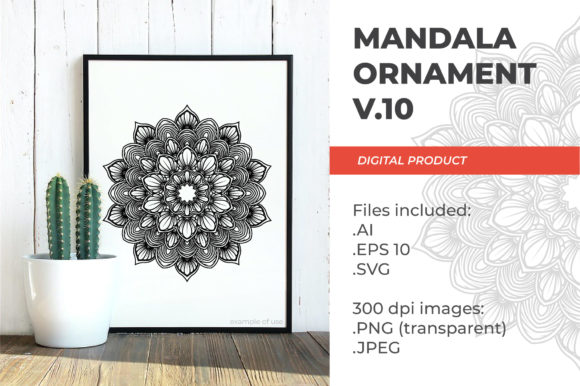
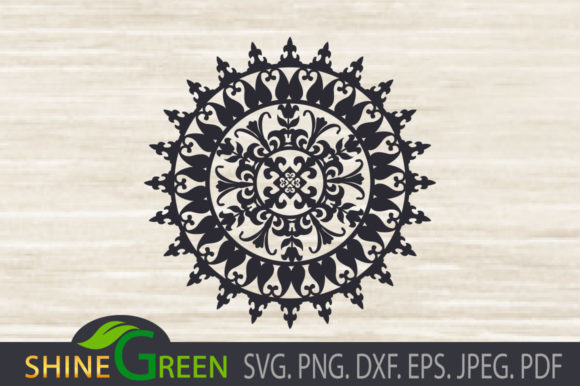
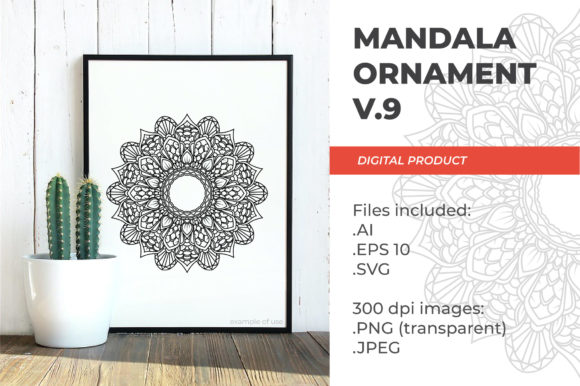
In the rapidly evolving landscape of digital creativity and print-on-demand commerce, the distinction between generic clip art and professional-grade design assets has never been more critical. Mandala - Floral Vintage - V.9 represents a significant shift in how creators, entrepreneurs, and hobbyists approach ornamental design. This digital product is not merely a static image; it is a comprehensive toolkit engineered for modern production workflows. By combining intricate vintage aesthetics with robust technical specifications—including .AI, .EPS, and .SVG vector formats alongside high-resolution 300 DPI raster files—this asset bridges the gap between artistic tradition and contemporary manufacturing requirements.
The relevance of this specific mandala ornament extends beyond its visual appeal. In an era where personalization and niche marketing dominate, having access to scalable, editable floral vintage designs allows users to maintain brand consistency across vastly different mediums. Whether you are a tattoo artist needing precise line work, a woodcarver requiring clean paths for CNC machines, or a marketer designing seasonal invitation cards, the utility of this asset lies in its adaptability. It addresses a common pain point in the creative industry: the need for high-quality foundational elements that can be modified without losing integrity or resolution.
The Evolution of Ornamental Design in Modern Workflows
Historically, acquiring detailed mandala art meant either spending dozens of hours drawing by hand or licensing expensive, restrictive stock photography that could not be altered. The release of comprehensive digital products like Mandala Ornament – Floral Vintage signals a maturation in the digital asset marketplace. We have moved past the era of low-resolution JPEGs that pixelate when resized. Today’s creators demand source files that respect the manufacturing process.
This evolution is driven by technological accessibility. With the proliferation of consumer-grade laser cutters, Cricut machines, and direct-to-garment printers, the barrier to entry for physical product creation has lowered. However, the software driving these machines requires specific file types to function correctly. A standard PNG might suffice for a web banner, but it fails catastrophically when sent to a vinyl cutter or embroidery digitizer. The inclusion of .SVG and .EPS formats in this package acknowledges that modern design is inherently multi-disciplinary. It reflects a market preference for "future-proof" assets that remain useful regardless of how output technologies change.
Furthermore, the aesthetic trend toward "vintage revival" is not just nostalgia; it is a response to the sterility of minimalist corporate design. Consumers are seeking warmth, complexity, and craftsmanship. Floral vintage mandalas offer a visual shorthand for quality and tradition. Yet, modern audiences also expect crispness and clarity. This digital product satisfies both needs by providing the romantic complexity of vintage florals rendered with mathematical precision suitable for digital reproduction.
Technical Specifications as Creative Enablers
Understanding the file structure of Mandala - Floral Vintage - V.9 is essential for maximizing its value. Each format serves a distinct purpose in the professional workflow:
- .AI and .EPS Files: These are the master vectors. For graphic designers and illustrators using Adobe Illustrator or CorelDRAW, these files allow for complete manipulation. You can adjust anchor points, thicken lines for screen printing, or separate color layers for spot color separation. This editability is crucial for avoiding copyright issues related to unaltered stock art; by modifying the vector, you create a derivative work unique to your project.
- .SVG Format: Scalable Vector Graphics are the industry standard for web display and crafting machines. Unlike raster images, SVGs use mathematical formulas to render shapes, meaning they remain perfectly sharp at any zoom level. For users of Silhouette Studio or Cricut Design Space, this format ensures smooth cutting paths without jagged edges.
- 300 DPI .PNG (Transparent): While vectors are superior for editing, high-resolution rasters are necessary for certain applications. The transparent background eliminates the tedious task of masking out white space, making it instantly usable for overlaying on dark shirts, mugs, or textured paper backgrounds. At 300 DPI, this file meets the minimum standard for professional offset and digital printing.
- .JPEG Files: Optimized for quick previews, social media mockups, or low-stakes digital uses where transparency and infinite scaling are not required.
The ability to scale these designs to any size and change colors is perhaps the most practical feature for business owners. Consider a scenario where a boutique hotel needs branding materials. They can use the same mandala motif for a large lobby wall decal (scaled up via vector), a small embroidered logo on staff uniforms (simplified vector paths), and a watermark on their website (raster). Maintaining visual identity across such disparate scales is only possible with this level of technical flexibility.
Practical Applications Across Industries
The versatility of Mandala - Floral Vintage - V.9 makes it a staple resource across multiple sectors. Its application goes far beyond simple decoration; it functions as a core component in product development and service delivery.
Apparel and Merchandise Production
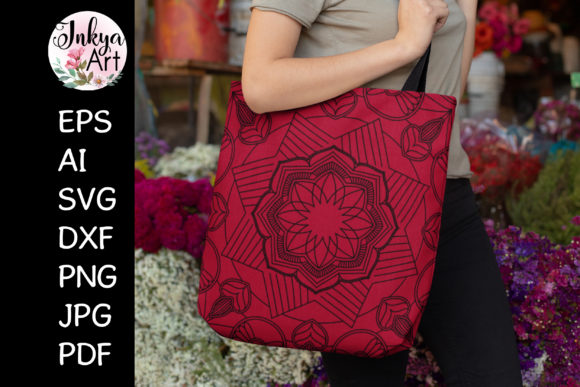
For print-on-demand sellers and clothing brands, this asset offers a solution to the saturation of generic t-shirt designs. Because the color can be changed, a single mandala design can spawn an entire collection. A muted earth-tone version appeals to the boho-chic demographic, while a high-contrast monochrome version suits streetwear. The transparent PNG facilitates easy placement on garment mockups, while the vector file ensures that direct-to-film (DTF) transfers retain fine details without bleeding.
Tattoo Artistry and Body Modification
Tattoo artists frequently utilize digital mandalas as stencils or reference bases. The clean lines of the vector format are ideal for creating flash sheets. Artists can isolate specific floral elements from the larger composition to create custom pieces that fit anatomical contours. The scalability ensures that whether the client wants a finger ring tattoo or a full back piece, the line weight and proportion can be adjusted digitally before the needle ever touches skin.
Woodworking and Laser Cutting
The maker community relies heavily on optimized vectors. For wood carving and laser engraving, the difference between a traced raster image and a native vector is profound. Traced images often contain noise and disconnected nodes that cause lasers to stutter or carve unevenly. The native .SVG and .EPS files included in this product provide continuous, logical paths that result in cleaner burns and smoother cuts. This reduces material waste and post-processing time for artisans creating ornaments, signs, or furniture inlays.
Paper Crafts and Event Stationery
Wedding planners and stationery designers leverage these floral vintage patterns to add texture and elegance to invitations. The ability to manipulate opacity and color allows the mandala to serve as a subtle background watermark or a bold header element. For DIY enthusiasts, the files are compatible with home cutting machines for creating intricate paper lace, cake toppers, and scrapbook embellishments. The 300 DPI resolution ensures that even printed raster versions look crisp on premium cardstock.
Navigating Customization and Commercial Viability
While the asset provides immense potential, successful implementation requires strategic customization. In a competitive marketplace, simply placing the unaltered mandala on a product is rarely sufficient. Professionals should view Mandala - Floral Vintage - V.9 as raw material rather than a finished good.
Color Theory Integration: Use the editable vector files to align the mandala’s palette with current seasonal trends or specific brand guidelines. A vintage design does not have to use vintage colors; applying a neon gradient or metallic gold effect can completely recontextualize the artwork for a younger demographic or luxury market.
Compositional Adaptation: Break the mandala apart. Use individual floral quadrants as corner accents for certificates or frame borders. Rotate and mirror elements to create new, non-circular patterns for textile printing. This modular approach maximizes the ROI of a single digital purchase.
Material Considerations: When preparing files for physical output, always consider the substrate. Intricate vintage details may get lost on coarse fabrics like burlap or canvas; in these cases, simplify the vector paths or increase stroke width. Conversely, for glossy phone cases or ceramic mugs, the full detail of the 300 DPI PNG will shine. Understanding the relationship between digital resolution and physical texture is what separates amateur results from professional products.
The Future of Digital Asset Utilization
As generative AI tools become more prevalent, one might question the continued relevance of curated digital assets. However, products like Mandala Ornament – Floral Vintage actually gain value in this context. AI-generated images often suffer from inconsistent geometry, broken symmetry, and raster-only outputs that are difficult to manufacture. A professionally designed, mathematically symmetrical vector mandala provides a reliable ground truth that AI cannot currently replicate with manufacturing precision.
Moreover, the legal clarity of licensed digital products offers security that AI generation lacks. For businesses and educators, knowing exactly what rights they possess and having access to original source files is a risk management necessity. As the creator economy continues to expand, the demand for high-integrity, versatile, and legally sound design components will persist.
Ultimately, Mandala - Floral Vintage - V.9 is more than a collection of pretty pictures. It is a functional instrument for modern creation. By providing industry-standard file formats and embracing the need for customization, it empowers users to translate digital beauty into tangible reality. Whether scaling up for a mural or scaling down for a jewelry pendant, the asset adapts to the user's vision, proving that in the digital age, true quality is defined by flexibility.