Evaluating the Floral Wedding Seating Chart Template for Practical Event Planning
Coordinating guest logistics is often the most complex aspect of wedding planning, requiring a balance between functional clarity and aesthetic cohesion. The Floral Wedding Seating Chart Template addresses this specific intersection by providing a pre-designed framework that integrates botanical visuals with structured typography. For professionals, freelancers, and DIY couples managing event production, this resource represents a practical solution to a common bottleneck: creating large-format signage without hiring a dedicated graphic designer or spending hours on layout composition.
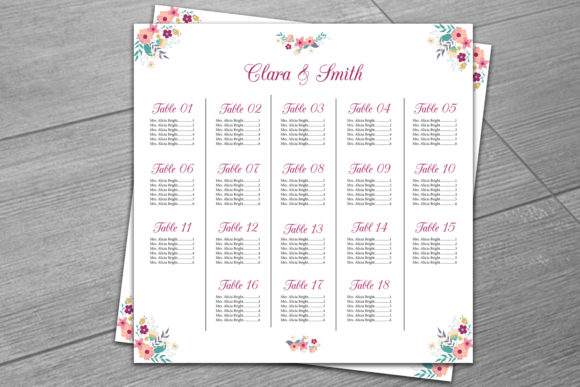
This template is designed as an instant download asset compatible with both Adobe InDesign and Microsoft Word. Its primary value lies in its dual-format accessibility, allowing users to choose the software environment that best matches their technical proficiency. Whether utilized by a small business owner creating client deliverables or a couple managing their own event stationery, the template serves as a foundational tool for organizing guest data into a visually appealing 22x22 inch format.
Technical Specifications and Format Flexibility
The utility of any digital design asset depends heavily on file compatibility and structural integrity. This Floral Wedding Seating Chart Template includes three distinct file types to ensure broad usability across different software versions and skill levels:
- InDesign CS6 (.indd): Ideal for users with current Creative Cloud subscriptions who require granular control over layers, master pages, and typography.
- InDesign CS4 (.idml): A backward-compatible interchange format that allows users with older versions of InDesign (CS4 and later) to open and edit the file without version conflicts.
- MS Word 2007-2013 (.docx): Provides an accessible alternative for users without Adobe software, enabling text editing and basic formatting within a familiar word processing environment.
The inclusion of the IDML file is a significant professional consideration. Many designers and agencies still operate on legacy systems or maintain archives in older formats; providing this bridge ensures the asset remains viable regardless of software generation. Similarly, offering a robust MS Word version acknowledges that not all stakeholders have access to professional layout tools. However, users should note that while Word offers convenience, it lacks the precision of InDesign for handling large-scale print layouts. Text reflow and image positioning may require manual adjustment in Word, whereas the InDesign files maintain locked structural relationships.
Workflow Efficiency and Customization Process
The stated purpose of this template is to streamline the creation process through an "edit and print" workflow. In practice, this involves downloading the files, opening them in the preferred application, and replacing placeholder content with actual guest lists. The font replacement process is straightforward: users select existing text blocks with the text tool and input new data. The help file includes download links for the original fonts used in the design, which is critical for maintaining visual consistency.
For professionals managing multiple events, this modularity supports rapid iteration. Rather than building a seating chart from scratch for each client, the floral background and ornamental elements serve as a consistent brand anchor, while the text areas remain flexible. This reduces production time significantly. For individuals, the learning curve is minimized because the hierarchy and spacing are already established. The user does not need to understand grid systems or typographic scale; they simply populate the existing containers.
A practical recommendation for efficient workflow is to prepare the guest list in a spreadsheet before opening the template. Sorting names alphabetically by table or by surname beforehand prevents errors during the transcription phase. Since the template is static, there is no automated data merge functionality described; accuracy relies entirely on manual entry. Double-checking spelling and table assignments against the master RSVP list is an essential quality control step that cannot be automated within this specific asset.
Design Quality and Print Considerations
The 22x22 inch square format is a versatile dimension for welcome signs and seating displays. It provides sufficient surface area for legible typography at a viewing distance of three to five feet, assuming appropriate font sizing. The floral artwork acts as a border or background texture, framing the information without competing for readability. From a design evaluation perspective, effective seating charts prioritize contrast; the template appears structured to keep text zones clear of high-density botanical illustrations, ensuring that function is not sacrificed for decoration.
When preparing this file for print, several technical factors influence the final output quality. Users must verify color profiles before sending files to a vendor. InDesign files typically allow for CMYK conversion and bleed management, which are necessary for professional offset or large-format digital printing. The MS Word version, however, is inherently RGB and may experience color shifts when converted by print vendors. Professionals using the Word version should communicate explicitly with their printer regarding color expectations or request a physical proof.
Paper selection also impacts the perceived value of the floral aesthetic. Botanical designs generally perform best on matte or uncoated stocks, which absorb ink slightly to create a softer, more organic appearance. Glossy finishes can make floral illustrations appear artificial and create glare that impedes readability under venue lighting. Given the instant download nature of this product, the end-user assumes responsibility for material selection, but choosing a paper weight above 80lb cover stock is advisable to prevent warping on easels.
Audience Fit and Use Case Analysis
Determining whether this Floral Wedding Seating Chart Template aligns with specific project needs requires an honest assessment of skills and resources. The asset delivers maximum value to three distinct groups:
- Budget-Conscious Couples: Those who want professional-grade stationery but cannot justify custom design fees. The affordability and instant availability make it a viable alternative to expensive bespoke services.
- Event Planners and Freelancers: Professionals who need reliable, editable templates to offer as part of package tiers. The multi-format inclusion allows them to service clients with varying levels of involvement in the design process.
- Small Business Owners: Stationers or print shop operators looking to expand their catalog with ready-made designs that can be quickly customized for walk-in customers.
Conversely, this template may not suit users seeking highly unique, avant-garde layouts or those requiring complex data automation. If a guest list exceeds 200+ names with intricate table configurations, the manual entry requirement in a fixed 22x22 layout could become tedious. Additionally, designers with strong personal aesthetics may find the pre-set floral style limiting if it does not match their specific vision. The template is a starting point, not a comprehensive branding suite.
Support, Reliability, and Long-Term Value
Digital assets carry inherent risks regarding support and longevity. The provider indicates availability for questions and custom requests, suggesting an active seller profile rather than an abandoned listing. This responsiveness is a key reliability metric for instant downloads, where file corruption or missing links can derail timelines. The explicit invitation for feedback and reviews also signals confidence in product quality and a willingness to iterate based on user experience.
From a long-term value perspective, the non-exclusive license typically associated with such templates means the design may appear at other events. For commercial users, this necessitates adding unique touches—perhaps modifying colors, adjusting element placement, or pairing the chart with custom table numbers—to differentiate client work. For personal users, the likelihood of duplication is statistically low and rarely impacts the individual event experience.
Ultimately, the Floral Wedding Seating Chart Template functions as a pragmatic utility. It solves the immediate problem of layout creation with reasonable flexibility and broad software compatibility. Success with this asset depends less on the file itself and more on the user’s preparation, attention to print specifications, and realistic expectations regarding customization depth. When approached as a professional tool rather than a magic solution, it effectively bridges the gap between blank canvas anxiety and finished event signage.