Evaluating Mandala - Floral Vintage - V.7 for Professional and Personal Creative Projects
Selecting the right digital asset for creative production requires balancing aesthetic appeal with technical versatility. Mandala - Floral Vintage - V.7 represents a specific niche within digital design resources, combining traditional ornamental symmetry with botanical motifs in a vintage style. For designers, crafters, and small business owners aged 20 to 50, the decision to acquire this asset often hinges on more than just visual preference; it depends heavily on file integrity, scalability, and application suitability. Understanding the technical specifications and practical limitations of this digital product is essential for determining whether it aligns with your current project requirements or if an alternative resource would be more appropriate.
Technical Specifications and File Format Utility
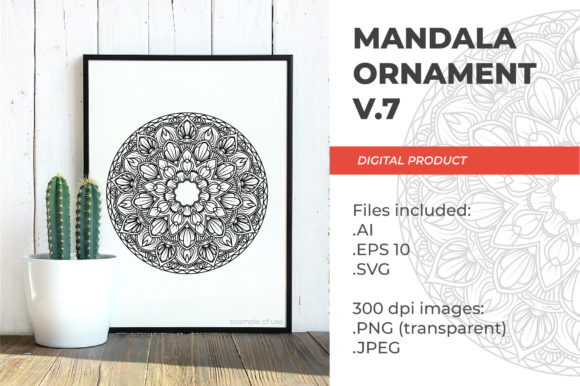
The value of any digital ornament lies in its adaptability across different media. Mandala - Floral Vintage - V.7 is distributed as a comprehensive digital package including .AI, .EPS, .SVG, 300 DPI .PNG (transparent), and .JPEG formats. Each format serves a distinct purpose in the production workflow, and understanding these differences is crucial for maximizing the asset's utility.
- Vector Formats (.AI, .EPS, .SVG): These are the primary source files for professional modification. Unlike raster images, vectors use mathematical paths rather than pixels. This allows the mandala to be scaled to any size—from a 2cm lapel pin to a 3-meter wall mural—without losing edge sharpness. The inclusion of .AI and .EPS ensures compatibility with industry-standard software like Adobe Illustrator and CorelDRAW, while .SVG provides broad support for web design and consumer-grade cutting machines like Cricut or Silhouette.
- Raster Formats (300 DPI .PNG, .JPEG): While vectors handle scaling, high-resolution rasters are necessary for direct printing and digital mockups. The 300 DPI specification is the industry standard for print clarity, ensuring that intricate floral details do not appear pixelated on physical products. The transparent .PNG is particularly vital for overlaying the design onto colored backgrounds, dark garments, or textured surfaces without needing to manually remove a white background.
When comparing Mandala - Floral Vintage - V.7 to lower-cost or free alternatives, the presence of editable vector files is often the deciding factor. Many budget resources only offer flattened JPEGs or low-resolution PNGs, which restricts users to fixed sizes and prevents color customization. If your workflow requires recoloring elements to match a specific brand palette or resizing for varied merchandise, the vector components of this package provide necessary flexibility that raster-only alternatives cannot offer.
Aesthetic Distinctions and Style Comparisons
The "Floral Vintage" designation places this asset in a specific stylistic category that differs significantly from other mandala variations. When evaluating options, it is helpful to distinguish between the primary mandala sub-genres available in the marketplace.
Vintage Floral vs. Geometric and Boho Styles
Mandala - Floral Vintage - V.7 emphasizes organic curves, petal layering, and classical ornamentation. This contrasts sharply with geometric mandalas, which rely on rigid lines, polygons, and mathematical precision. Geometric styles often convey modernity, technology, or minimalism, making them suitable for corporate branding or contemporary architecture. In contrast, the vintage floral approach evokes nostalgia, craftsmanship, and natural warmth.
Similarly, this style differs from "Boho" or tribal mandalas, which typically feature higher density, tighter spacing, and cultural iconography. While Boho designs excel in textile patterns and festival aesthetics, they can sometimes lack the negative space required for certain applications like wood carving or single-color tattoos. The vintage floral style generally offers better separation between elements, providing clearer definition when translated into physical mediums where fine detail might be lost.
Evaluating Complexity for Specific Mediums
Not all mandalas are created equal regarding manufacturing constraints. A design that looks stunning as a digital art print may fail as a laser-cut wooden ornament. Mandala - Floral Vintage - V.7 appears optimized for multi-medium use, but users must still evaluate line weight and connectivity based on their specific output method.
- Wood Carving and Laser Cutting: Requires continuous paths and sufficient material bridges. Intricate floral stamens or disconnected petals in some vintage designs can result in fragile pieces that break during handling. Users should test the vector file at the intended scale before mass production.
- Tattoo Artistry: Demands clean flow and aging consideration. Highly detailed vintage shading may blur over time on skin. The ability to edit the .AI or .EPS file allows tattoo artists to simplify internal details or thicken lines for longevity, a significant advantage over pre-rendered images.
- Textile and Apparel Printing: Benefits from the transparent PNG and color-editable vectors. For shirts and bags, the vintage aesthetic pairs well with earth tones and muted palettes. However, users should verify that the design’s aspect ratio fits the printable area of their specific garment without requiring excessive cropping.
Customization Capabilities and Workflow Integration
A key decision factor for professionals is the ease of integration into existing workflows. The statement that Mandala - Floral Vintage - V.7 "can be changed color" implies full vector editability, but the practical reality depends on user skill level and software access.
For users proficient in vector editing software, this asset serves as a foundational template. Layers can be isolated to create repeating patterns, individual floral elements can be extracted for standalone use, or the entire composition can be recolored to match seasonal themes. This modularity extends the product's lifespan far beyond a single use case. Conversely, users without vector editing skills are limited to the provided raster files. While the 300 DPI PNG allows for basic placement on invitations or mugs, the inability to alter colors or separate elements reduces the asset's long-term ROI compared to learning basic vector manipulation or hiring a designer for modifications.
When comparing this product to subscription-based design services, the tradeoff is ownership versus variety. Subscriptions offer thousands of assets but often restrict commercial licensing or cease access upon cancellation. Purchasing Mandala - Floral Vintage - V.7 as a standalone digital product grants perpetual usage rights (subject to the specific license terms), making it more cost-effective for signature designs used repeatedly across branding materials, packaging, and merchandise.
Decision Framework: When This Asset Fits and When It Doesn’t
To make an informed purchasing decision, consider the following scenarios where Mandala - Floral Vintage - V.7 is likely the optimal choice versus situations where alternatives should be sought.
Ideal Use Cases
- Multi-Format Merchandise Lines: If you plan to apply the same design across stickers, phone cases, and canvas prints, the included file variety eliminates the need for manual conversion or redrawing.
- Customizable Client Work: For designers creating wedding invitations or event branding who need to adjust hues to match specific color schemes without compromising quality.
- Physical Craft Production: Makers using CNC routers, laser engravers, or vinyl cutters who require clean vector paths rather than traced bitmaps.
- Vintage/Romantic Aesthetic Projects: Designs targeting demographics that appreciate classical ornamentation over modern minimalism or abstract geometry.
Situations Requiring Alternatives
- Ultra-Minimalist Branding: If the target aesthetic is stark, corporate, or futuristic, the ornate nature of vintage florals may clash with brand identity. Simple line-art or geometric mandalas would be more appropriate.
- Low-Resolution Web-Only Use: If the sole purpose is a small website favicon or social media avatar, the full vector suite may be unnecessary overhead. Optimized web graphics or simpler icons could suffice.
- Cultural Authenticity Requirements: If the project specifically calls for traditional sacred geometry or culturally specific mandala forms (e.g., Tibetan sand painting replicas), a generic "vintage floral" interpretation may not meet authenticity standards. Specialized cultural assets or commissioned artwork would be preferable.
- No Vector Editing Access: If you lack software to open .AI/.EPS files and have no intention of acquiring it, verify that the pre-rendered PNG/JPEG options meet all your needs before purchase. Otherwise, seek assets marketed specifically as "print-ready" or "no-editing-required."
Practical Considerations for Digital Asset Acquisition
Beyond aesthetics and file types, responsible evaluation includes assessing licensing and technical support. While Mandala - Floral Vintage - V.7 provides robust technical specs, users should always review the specific license agreement regarding commercial use, redistribution, and attribution. Digital products vary widely in permitted applications; what is allowed for personal sticker making may differ from mass-produced retail merchandise.
Additionally, consider the learning curve associated with maximizing the asset. The ability to scale and recolor is only valuable if the user possesses or is willing to develop the skills to execute those modifications. For beginners, pairing this purchase with tutorials on vector basics can transform a static download into a dynamic design tool. For experienced professionals, the asset’s true value emerges from how efficiently it integrates into established production pipelines, reducing time-to-market for new product lines.
Ultimately, Mandala - Floral Vintage - V.7 occupies a middle ground between decorative clipart and professional design infrastructure. Its strength lies in versatile file delivery and a broadly appealing aesthetic that suits numerous commercial and personal applications. By carefully weighing technical requirements against project goals, users can determine whether this specific vintage floral iteration provides the foundation needed for their creative endeavors or if a different stylistic or technical solution would yield better results.